Hydroponic Strawberries: Complete Indoor Growing Guide
Grow hydroponic strawberries indoors: sourced pH, EC, temperature and light targets, the best day-neutral varieties, system choice, hand pollination and troubleshooting.
- Author
- Najeeb
- Published
- Updated
Hydroponic strawberries are strawberry plants grown with their roots in a nutrient solution or an inert substrate such as coco coir and perlite, instead of in garden soil. Indoors, that lets you pick fruit year-round, but strawberries are not as forgiving as lettuce. They want a mildly acidic, low-strength nutrient solution, warm days with cool nights, plenty of light, a dry crown and help with pollination. Get those five things right and a small indoor system can keep producing for six months to a year.
This guide gives you the numbers first, then explains how to set up and run a home system. Every target below comes from university controlled-environment research; the source is named next to each figure.
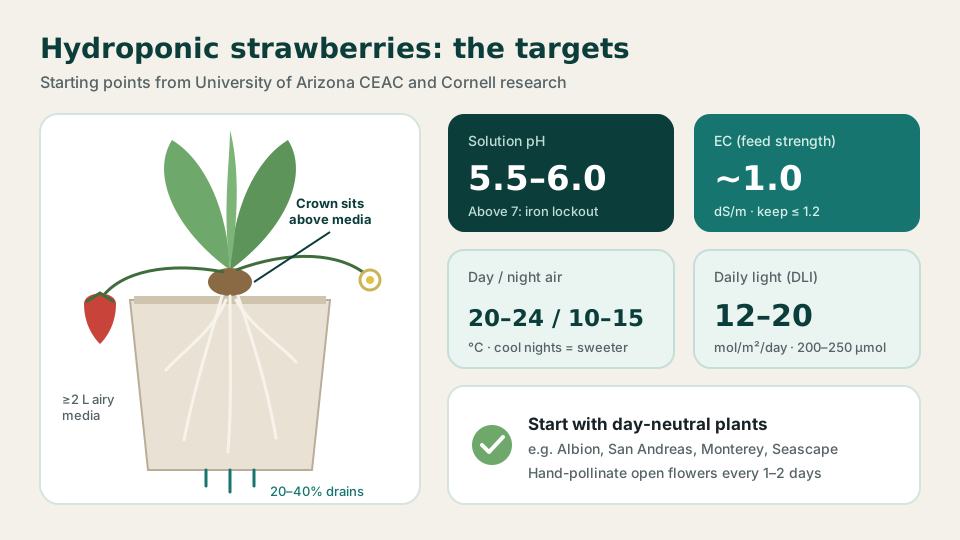
Quick answer: hydroponic strawberry targets
| Factor | Target | Source |
|---|---|---|
| Nutrient solution pH | 5.5–6.0 | University of Arizona CEAC |
| Electrical conductivity (EC) | About 1.0 dS/m (mS/cm); Cornell reports 1.2 works in most cases | University of Arizona CEAC; Cornell |
| Day air temperature | 20–24 °C (68–75 °F) | University of Arizona CEAC |
| Night air temperature | 10–15 °C (50–59 °F); Cornell used 72 °F day / 58 °F night | University of Arizona CEAC; Cornell |
| Crown temperature | About 18 °C (64 °F) | University of Arizona CEAC |
| Daily light integral (DLI) | Minimum 12, optimum about 20 mol/m²/day | UA CEAC short course |
| Light intensity under LEDs | 200–250 µmol/m²/s gave good indoor results | UA CEAC short course |
| Relative humidity | 50–60 % day, about 75 % night | UA CEAC short course |
| Root-zone volume (substrate) | At least 2 L per plant | UA CEAC short course |
| Drainage from substrate | 20–40 % of what you apply | Cornell; University of Arizona CEAC |
Two points matter more than the rest. First, strawberries want a much weaker solution than tomatoes: the University of Arizona notes a strawberry-specific solution sits near 1.0 dS/m at full strength, while typical tomato solutions are around 2.4 dS/m. Second, night temperature controls flavour: the UA CEAC short course reports that nights above roughly 16–18 °C raise acidity and lower the sugar-to-acid balance.
You can also look up strawberry targets alongside other crops in the pH and EC target table.
What are hydroponic strawberries, and are they healthy?
A hydroponic strawberry is the same species and variety you would buy as a garden plant; only the root environment changes. The plant still takes up water and mineral nutrients through its roots, so fruit quality depends on variety, light, temperature and harvest timing rather than on the word “hydroponic.” There is no evidence that a well-grown hydroponic berry is nutritionally worse than a soil-grown one, and HydroRigor makes no claim that it is better. What hydroponics does change is control: you decide the feed strength, the root temperature and the light, which is why indoor growers can harvest outside the normal season.
Choose the right variety: day-neutral first
Strawberries fall into three flowering groups, and the choice decides whether your indoor system fruits continuously or in short bursts.
- Day-neutral varieties are not sensitive to day length: they flower and fruit whenever temperatures are moderate. University of Minnesota Extension lists ‘Albion’, ‘Evie-II’, ‘Monterey’, ‘Portola’, ‘San Andreas’ and ‘Seascape’. This is the group to start with indoors.
- Everbearing (long-day) varieties flower when days are long. The University of Arizona uses a 4-hour day extension with low-intensity light to trigger this response.
- June-bearing (short-day) varieties flower after short days or cool temperatures. Cornell notes they give two to three flushes of fruit, usually from pre-chilled plug plants, which makes them harder to manage at home.
Cornell’s indoor work used ‘Albion’ and ‘Cabrillo’. Their growers describe ‘Albion’ as sweeter but lower yielding and ‘Cabrillo’ as higher yielding, and day-neutral plants as fruiting continuously for six months to a year.
Recommendation for a first indoor crop: buy certified disease-free day-neutral plants, ideally ‘Albion’, ‘San Andreas’, ‘Monterey’ or ‘Seascape’, from a nursery that names the cultivar on the label. Avoid seed for your first crop; it adds months and you cannot be sure of the variety.
Pick a hydroponic system
Strawberries grow well in several systems. The main question is how you will keep the roots wet and oxygenated while keeping the crown dry.
| System | How it works | Good for | Watch out for |
|---|---|---|---|
| Substrate (coco/perlite) with drip | Pots, bags or gutters of inert media fed several times a day, with run-off | Beginners who want a buffer against mistakes; closest to commercial practice | Needs a timer and drainage; overwatering suffocates roots |
| NFT (nutrient film technique) | A thin film of solution flows along a sloped channel | Compact runs of many plants; vertical towers | A pump failure dries roots within hours; channels can clog as roots grow |
| Deep water culture (DWC) | Roots hang in aerated solution under a floating board | Small setups and rooting runner plants | Only the bottom of the crown should touch the water |
| Vertical towers | Stacked pockets fed from the top | Growing many plants in a small footprint | Light falls off for lower pockets; check each level |
Recommendation: for a first crop, use substrate-filled pots or a gutter with drip irrigation and free drainage. It is the most forgiving. If you want NFT, read the NFT strawberry guide first; for floating-raft setups, see the deep water culture guide.
For substrate, the UA CEAC short course suggests at least 2 L of media per plant, with high air space (around 15 % air porosity) and an example mix of 50 % perlite, 25 % coconut coir and 25 % peat. Strawberry roots rot quickly in media that stays saturated.
Plant correctly: protect the crown
The crown is the short, thick stem where leaves, flowers and runners emerge. It is the part most likely to rot.
- Rinse soil off bare-root plants and trim any dead roots.
- Set the plant so the top of the crown sits just above the media or water line. In Cornell’s DWC runner work, plants were held so that only the bottom of the crown touched the water.
- Keep the media around the crown slightly drier than the root zone below it.
- Remove the first flowers for a few weeks so the plant can build roots and leaves. University of Minnesota Extension recommends removing flowers for four to six weeks after planting, until plants have five or six expanded leaves (a field recommendation; indoors, use plant size as your guide).
Cornell growers limit each plant to a maximum of three crowns and four flower clusters (inflorescences), which keeps fruit size up.
Feed and water: low EC, steady pH
Nutrient strength
Use a complete hydroponic nutrient that includes calcium and micronutrients, mixed to a low strength:
- Start around 1.0 dS/m (1.0 mS/cm, roughly 500 ppm on a 0.5 conversion meter). The University of Arizona recommends keeping EC at 1.0 dS/m or less.
- Do not push above about 1.2. Cornell reports 1.2 mS/cm works in most cases, and the UA CEAC short course warns that higher EC risks watery-flavoured fruit.
- Raise or lower strength gradually as plants move from leafy growth to fruiting, and always follow your nutrient manufacturer’s dilution directions for the base dose.
Not sure how to reach a target EC? Follow the steps in how to mix hydroponic nutrients and scale label doses with the nutrient mixing calculator.
pH
- Keep the solution between pH 5.5 and 6.0 (University of Arizona).
- If root-zone pH climbs above about 7.0, the University of Arizona notes iron deficiency becomes likely; it shows first as yellow-green young leaves.
- Check pH every day or two in recirculating systems, because it drifts as plants feed.
Watering schedule for substrate systems
The University of Arizona describes small, frequent irrigations: about 33 mL per plant per event, 6–12 events a day, totalling roughly 200–400 mL per plant daily depending on plant size and conditions. Aim for 20–40 % of the applied solution to drain out the bottom, which stops salts building up. Cornell’s example used five three-minute waterings a day through a half-gallon-per-hour emitter.
A fixed timer is only a starting point. University of Illinois Extension observed that water use changes as plants grow, set fruit and receive more light, so check drainage and adjust.
Light: the factor most indoor growers under-supply
Fruit needs far more light than leafy greens. The UA CEAC short course gives a minimum daily light integral (DLI) of 12 and an optimum near 20 mol/m²/day, and reports good results from 200–250 µmol/m²/s under indoor lighting. Strawberries appear more sensitive to very high light than many crops, so more is not always better.
DLI depends on both intensity and hours. Use this to plan your lamp height and timer (DLI = PPFD × hours × 0.0036):
| LED intensity at the canopy (µmol/m²/s) | 12 h on | 14 h on | 16 h on |
|---|---|---|---|
| 200 | 8.6 | 10.1 | 11.5 |
| 250 | 10.8 | 12.6 | 14.4 |
| 300 | 13.0 | 15.1 | 17.3 |
| 350 | 15.1 | 17.6 | 20.2 |
Recommendation: with day-neutral plants, aim for at least 250 µmol/m²/s for 14–16 hours a day, giving roughly 12–14 mol/m²/day, and increase toward 17–20 if plants are leggy or fruit is small. Measure with a PAR (quantum) meter rather than a lux app; the University of Arizona advises using µmol/m²/s rather than lux or footcandles.
Temperature and humidity
- Days 20–24 °C, nights 10–15 °C (University of Arizona). Photosynthesis peaks near 20 °C.
- Keep nights cool. A 6–10 °C day-to-night drop is what improves sweetness; warm nights above about 16–18 °C make fruit more acidic.
- Crown around 18 °C. The University of Arizona reports that controlling crown temperature raised winter yields by about 10 %.
- Humidity 50–60 % by day and about 75 % at night (UA CEAC short course), with gentle, constant air movement through the canopy to reduce powdery mildew and grey mould.
In a home, the night temperature drop is often the hardest target. A grow tent in a cooler room, or lights scheduled to run during the cooler part of the day, can help.
Pollinate by hand indoors
University of Minnesota Extension notes that most strawberry varieties are self-fruitful, but wind moves some pollen and insects are the primary pollinators; complete pollination matters for well-formed fruit. An indoor room has no insects, so small, lumpy or misshapen berries usually point here first. The hand-pollination routine below is a conservative application of the source’s flower biology to indoor growing:
- Pollinate every one to two days while flowers are open, preferably mid-day when pollen is dry.
- Use a small, soft paintbrush and gently swirl it over the yellow centre of each open flower, moving from flower to flower.
- Alternatively, a small fan aimed across the flowers adds some help, and gently vibrating each flower cluster (some growers use an electric toothbrush on the stem) releases more pollen.
Commercial greenhouses use bumblebees or honeybees for the same reason.
Harvest and ongoing care
- Pick berries when they are fully red to the shoulders. Cornell harvests at least three times a week; at home, check every one to two days.
- Remove runners unless you want new plants, because they divert energy from fruit.
- Strip dead or yellow leaves and keep fruit off wet surfaces.
- To make your own plants, root runner tips in aerated water: in Cornell’s trial, roots reached 10–20 cm in about two weeks, and ‘Cabrillo’ produced about 50 % more runner plants than ‘Albion’.
Troubleshooting common problems
| Symptom | Likely cause | What to do |
|---|---|---|
| Small, misshapen berries | Poor pollination | Hand-pollinate every 1–2 days; add gentle air movement |
| Sour or watery fruit | Warm nights, EC too high, or low light | Cool the night period; keep EC at or below about 1.0–1.2; check DLI |
| Yellow-green young leaves | High pH locking out iron | Bring solution pH back to 5.5–6.0 |
| Crown turning brown or soft | Crown kept wet; rot | Raise the plant so the crown sits above the water or media |
| Wilting with wet media | Root suffocation from over-watering | Water less often; check that 20–40 % drains away |
| White powder on leaves | Powdery mildew | Increase air movement; avoid humidity swings; remove affected leaves |
| Lots of leaves, few flowers | Wrong variety type or too little light | Use day-neutral plants; raise DLI |
Weekly checklist
- Check pH and EC (daily in small recirculating systems).
- Look at the crown, roots, new leaves, flowers and fruit.
- Confirm water reaches every plant and that drainage is happening.
- Hand-pollinate open flowers.
- Pick ripe fruit and remove runners and dead leaves.
- Record water and nutrient additions so you can spot trends.
- Calibrate your pH meter regularly against fresh buffer solution.
Next steps
If you are choosing equipment, start with indoor hydroponic systems for home and our hydroponic nutrients guide. For a channel-based setup, continue to NFT hydroponic strawberries.
Targets in this guide come from university and extension sources listed below, collected from commercial and research settings. Home conditions vary, so treat them as starting points and adjust to how your plants respond. HydroRigor has not run its own strawberry trial for this guide.
Sources and references
- Hydroponic Strawberry Irrigation
University of Arizona CEAC Hydroponic Strawberry Information Website · Accessed
- Hydroponic Strawberry Environmental Control
University of Arizona CEAC Hydroponic Strawberry Information Website · Accessed
- Hydroponic Strawberry Supplemental Lighting
University of Arizona CEAC Hydroponic Strawberry Information Website · Accessed
- From Planting to Harvesting: The Basics of Indoor Strawberry Production
Greenhouse Grower (Gagne, Allred and Mattson, Cornell University) · Accessed
- Berries in Controlled Environment Agriculture
University of Arizona CEAC Short Course (Karla Garcia, Hort Americas) · Accessed
- CEA Strawberry Runner Propagation for Deep Water Culture
Cornell Controlled Environment Agriculture · Accessed
- Day-neutral strawberries
University of Minnesota Extension · Accessed
- How strawberry plants grow
University of Minnesota Extension · Accessed
- Hydroponic day-neutral strawberry production observations
University of Illinois Extension · Accessed
- Controlled Environment Agriculture: Hydroponic Farming
University of Missouri Extension · Accessed